Probiotic Intervention at Living Assembly Pavilion, London Design Biennale 2025
Prototype of Probiotic Intervention at the London Design Biennale 2025.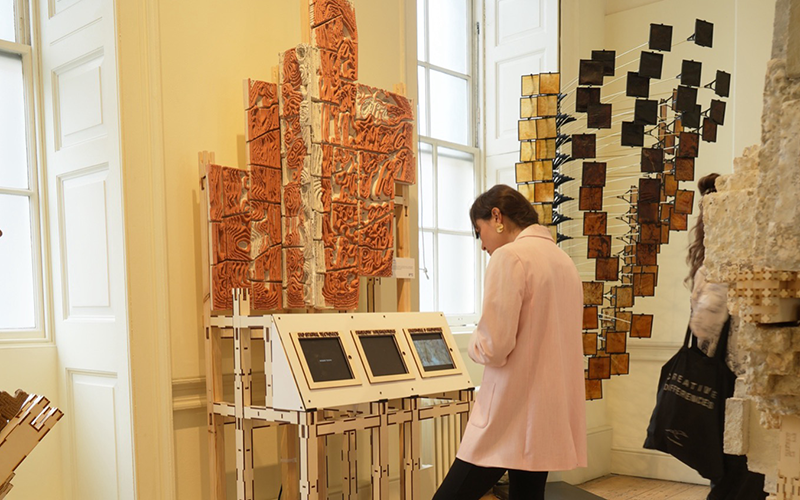

Prototype of Probiotic Intervention at the London Design Biennale 2025.
Environmental-Driven Making, publication in CAADFutures, 2025 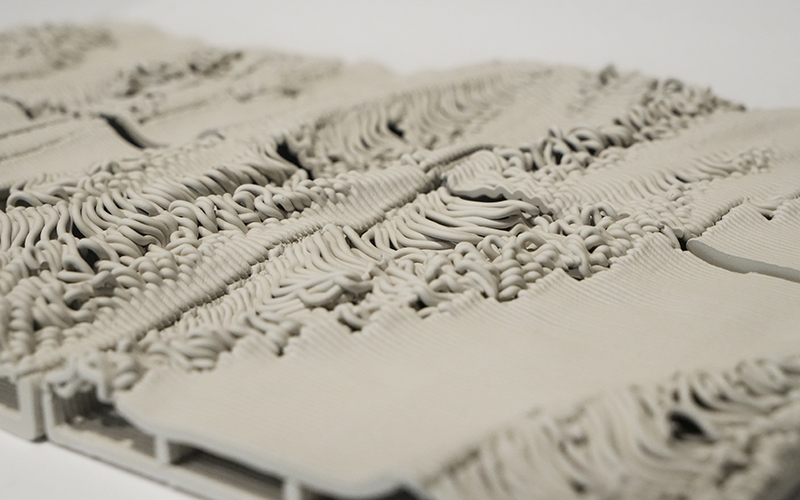
Master thesis project - Biohealer.ai, 2022 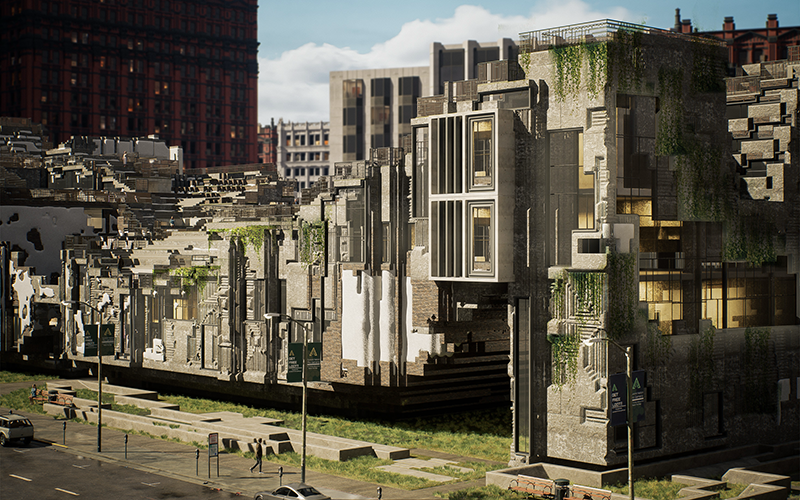
Published in DC I/O 2025, 2022
This article provides an overview of a generative framework embedded with a ML approach to apply CFD in building design, finally results on a building massing with a balanced wind environment at the early stage of architectural design.
Recommended citation: Wei, H., Adilenido, Y., & Beckett R. (2022). Environmental-driven Massing Based on Machine learning. Design Computation Input/Output 2022. https://doi.org/10.47330/dcio.2022.eqad1156
Download Paper
Published in CAADRIA 2025, Tokyo University, 2025
The study investigates the impact of macroscale porosity on deformation in 4D-printed hygromorphic bilayer structures, focusing on applications in building envelopes.
Recommended citation: Liu, Y., Wei, H., Colletti, M., & Grigoriadis, K. (2025). Programming bilayer structures in 4D-printed hygromorphs by tailoring porosity in macroscale. Association for Computer-Aided Architectural Design Research in Asia (CAADRIA).
Download Paper
Published in Towards Integrative Design Symposium, Innsbruck University 2025, 2025
this study integrates computational design methods to facilitates the conceptualization of probiotic surface design interventions. It develops a probiotic ceramic tiling system whereby environmentally informed toolpaths, textures and geometrical articulations, act as niches to support probiotic microbial communities based on computational design.
Recommended citation: Wei, H., Scott, W., Hoenerloh, A., Leyton Dominguez, A., Nair, S., & Beckett, R. (2025). Probiotic Design Interventions for The Indoor Microbiome. Cambridge Open Engage. doi:10.33774/coe-2025-pzt7t-v2 This content is a preprint and has not been peer-reviewed.
Download Paper
Published in CAAD Futures 2025, Hong Kong University, 2025
This paper is developed primarily using Houdini, where CFD data continuously informs the generation of geometry, tool paths, and 3DP instructions. A customized slicing tool and G-code generator are implemented to produce G-code programs responsive to CFD data. Unlike conventional 3DP practices, this integrated approach enables the production of environmentally responsive surface textures, establishing a continuous link between environmental factors, design generation, and digital fabrication.
Recommended citation: Wei, H., Colletti, M., & Beckett R. (2025). Environmental-driven Making: Clay 3D Printing Instructed by Airflow Data. CAADFUTURES 2025. https://doi.org/10.25442/hku.29350490.v1
Download Paper
Published in Design Mycelium: Exploring the Design Potential of Fungi (Routledge) [forthcoming], 2025
A book chapter examining bio-spatial tectonics in the context of mycelium-based design, exploring the design potential of fungi within architectural and material design frameworks.
Recommended citation: Beckett, R., Whiteside, C., & Wei, H. (2025). Bio-spatial Tectonics. In Crawford, A., & Dessi-Olive, J. (Eds.), Design Mycelium: Exploring the Design Potential of Fungi. Routledge. [forthcoming]
Published:
[Abstract:] Digital fabrication is often regarded as a distinct materialization process, separate from design, resulting in a disconnection between digital models and their physical making. This paper introduces a generative framework for environmental-driven making using ceramic 3D printing (3DP). The study examines the plastic deformation of 3DP ceramic and integrates computational fluid dynamics (CFD) simulation data to regulate deformation within the design. This approach generates surface textures with different roughness that can potentially influence the bio-receptivity, through which it creates niches for microbial colonization while also contributing to aesthetic considerations. The framework is developed primarily using Houdini, where CFD data continuously informs the generation of geometry, tool paths, and 3DP instructions. A customized slicing tool and G-code generator are implemented to produce G-code programs responsive to CFD data. Unlike conventional 3DP practices, this integrated approach enables the production of environmentally responsive surface textures, establishing a continuous link between environmental factors, design generation, and digital fabrication.
Published:
Speaker at the Probiotic Cities Symposium at UCL, presenting Probiotic Intervention — a computational design and ceramic 3D-printing framework for shaping the indoor microbiome through bio-receptive surfaces.
Published:
Published:
I was invited by Prof. Christiane M. Herr (Candy) to give a talk about my PhD research and discuss with members from, Future Ecologies Research group at Southern University of Science and Technology (SUSTech), Shenzhen.
Published:
Panellist at the launch event of AD Biodesign in Architecture (Architectural Design, Vol. 96.1), with Rachel Armstrong and Richard Beckett. The panel discusses biodesign as an expanded field of architectural practice — bridging microbiome science, materials, and computational design.
Postgraduate teaching, University College London, the Bartlett School of Architecture, 2023
-Teaching Bio-digital design theory, methodology and instruct design projects, in Research Cluster 7. -Instructed project BioCorbel won silver medal in Autumn Show 2024; Project B.L.U.R won gold medal in Autumn Show 2025.
Postgraduate course, University College London, the Bartlett School of Architecture, 2024
Teaching M.Arch Architectural Design, a postgraduate course with 16 students, covering the following topics: Generative Design in Houdini, Machine Learning, Digital Architecture.
Teaching Assistant, University College London, the Bartlett School of Architecture, 2025
To support M.Arch Urban Design studios, deliver digital design skilling sessions, assist assessment and reviews, mentor students with research-led design communication.
Conference Workshop, CAADRIA 2026, National Yang Ming Chiao Tung University (NYCU), 2026
Sequenced Robotic Tool Paths: 3D Scanning and Bio-Printing on Organic Topology — Workshop A04, CAADRIA 2026.
International Workshop, DigitalFutures 2026, Tongji University, 2026
Co-proposed and co-instructed a 9-day international workshop at DigitalFutures 2026, Tongji University, exploring how generative AI can assist the design of clay-3D-printed green infrastructures, integrating ecological intention with computational fabrication.